
I’ve been thinking about the following question for a while: Why do normal everyday people who ground their moral commitments in secular politics or philosophy so often appear more aware of what is wrong with the immediate world around them, more organised in their response to it, and more willing to act against it, than people who claim to follow God’s final Proclamation (al-Qur’ān)? Obviously, this question doesn’t come from any cynicism about the covenantal tradition but confronting the distance between what it demands and the Frankenstein that modern religiosity has made of it.
The Arabic word islāh as frequently used in the final Proclamation (al-Qur’ān) carries within it an entire programme for how a people should inhabit the world. It means rectification, repair, restoration and the setting of things right. It speaks of mending what has been broken, rebalancing what has been thrown into disorder, and reviving what has been left to rot and decay. It stands in direct opposition to fasād: corruption, exploitation, disorder and ruin in the land. Together, these two words form one of the central axes of the Proclamation, and they appear throughout the Tanakh and Gospel in closely related forms. The Midianite prophet Shu’ayb, speaking to the people of Midian, declared without ambiguity: “I only desire islāh so far as I am able, and my success is only through God – in Him I trust and to Him I turn” (11:88). Isaiah, speaking to the Israelites with the kind of moral directness that this divinely ordained tradition has always demanded, told them that the fast God wants is not personal abstinence but something far more demanding: loosening the chains of injustice, sharing food with the hungry, and bringing the poor wanderer into your house (Isaiah 58:6-7). When Jesus stood in the synagogue at Nazareth and read from Isaiah, he described his entire mission as good news to the poor, release to the captive and freedom for the oppressed (Luke 4:18). Across all three communities: the Israelites, the Messiah’s legacy and the Ishmaelites, the announcement of God’s sovereignty arrives as a programme for repairing a world that has broken from its covenantal order. There can be no doubt about this.
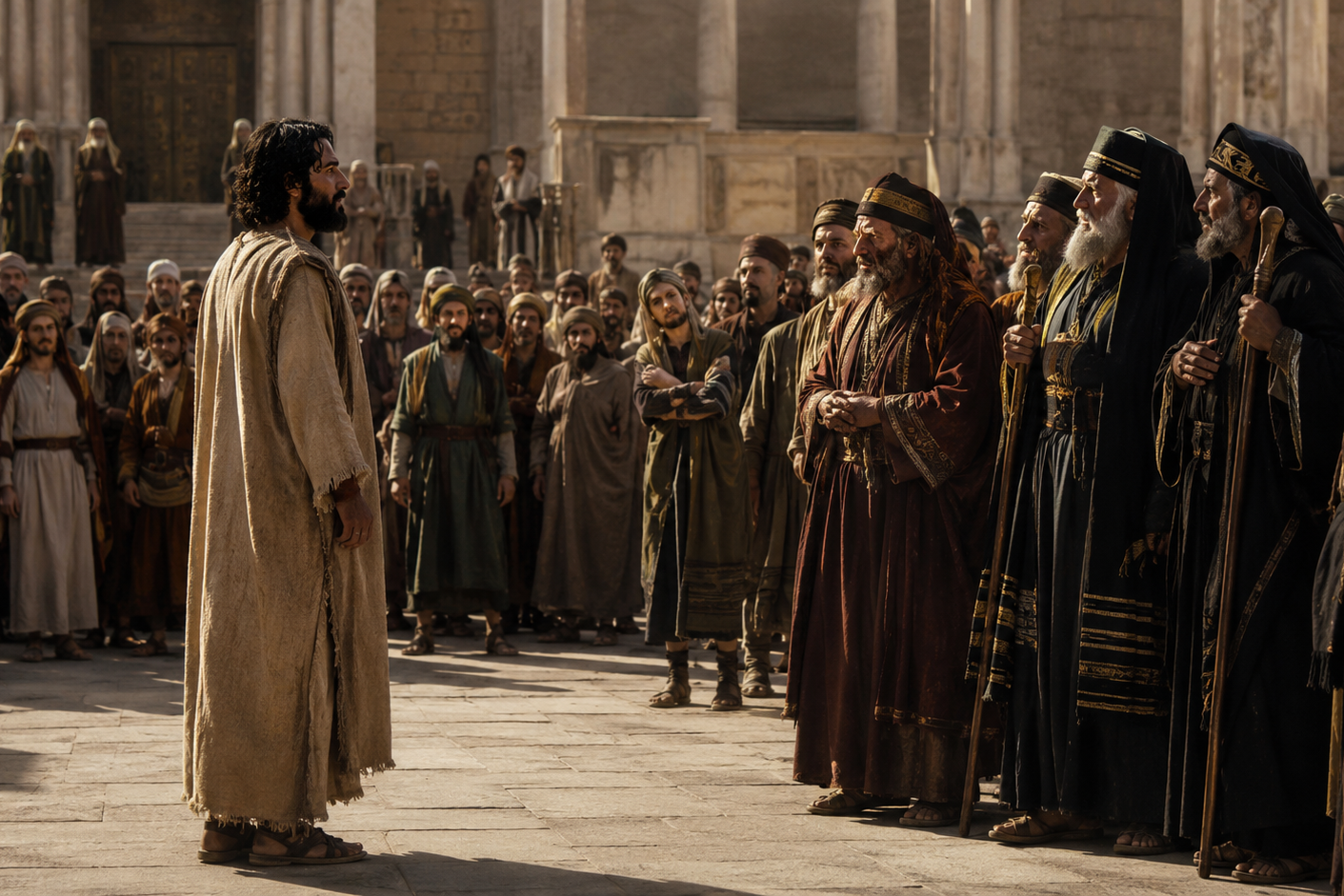
Islāh (reform) is therefore the work of bringing human life back into alignment with the order God has established for human flourishing. It’s a word that belongs to history, to the actual condition of the land, to the material and social arrangements that shape how people live day to day. The Prophets were not detached mystics offering inward consolation to the spiritually curious as much as modern religion would like to portray them. They confronted the structures of their world with the moral standard of God’s covenant: “We took a strong pledge from the prophets: from you, from Noah, from Abraham, from Moses, from Jesus son of Mary… We took a strong pledge from all of them: God will even question the truthful about their integrity, and for those who reject the truth He has prepared a painful torment.” (33:7-8) Noah warned a people whose corruption had become systemic. Abraham challenged the false authority of political chief priests and the power that sustained them. Moses stood before Pharaoh, the greatest political and economic power of his age, questioned his authority and demanded the liberation of an enslaved people. Amos addressed the prosperous classes of the Israelites with language that still carries force: God despised their festivals, rejected their offerings and refused to hear their music, because justice had dried up like a stream in summer while the poor were crushed in the courts of the city (Amos 5:21-24). The Proclamation states the purpose of prophethood plainly: “We sent Our messengers with clear proofs and sent down with them the Covenant Book and the Balance, so that people might uphold justice” (57:25). The mission was always public, historical and concerned with the structures of power from the very beginning.
This is what makes the contrast with contemporary religiosity so striking. A Muslim today will commonly speak of Noah, Abraham, Moses, Shu’ayb, Lot and Jesus as prophets worthy of reverence, telling their stories in the Quran and how they addressed society, but then treat the venerable and final messenger, Muhammad, as though his mission were a departure from everything that came before him, the delivery of private ritual rather than a restoration of the Abrahamic covenant as a complete ordering of human life. God’s final Proclamation insists on the opposite.
Muhammad was sent to confirm and complete what was sent to those before him, and what was sent before him was a covenantal programme covering the soul, the family, the market, the court and the land. The Proclamation doesn’t present faithfulness as one thing and public responsibility as something added to it later. Faithfulness simply is covenantal responsibility, directed inward and outward at the same time, disciplining the self so that it becomes capable of upholding God’s order in the world. Given this, the question of why politically conscious secular people often appear more awake than religious people isn’t just some anthropoligical observation. It’s an indictment that the tradition itself demands of those who claim it to take seriously.
Those who orient their political life around the concerns of the left, at their best, bring to public life a set of questions that belong recognisably to that prophetic inheritance. They look at housing, wages, healthcare, labour conditions, the concentration of wealth and the capture of institutions by powerful interests, and they ask who this arrangement benefits and who it harms, how the suffering is produced and maintained, and what would need to change to correct it. They understand that poverty is, in most cases, the product of structured relationships rather than individual failure. They understand that exploitation rarely announces itself, preferring instead the vocabulary of freedom, merit and natural order. They recognise that power, wherever it operates without accountability, tends toward corruption, and that corruption, once embedded in institutions, reproduces itself across generations without requiring anyone to consciously intend it. These instincts sit close to the covenantal tradition. Amos didn’t treat the suffering poor of Samaria as though their condition were the result of personal vice, he identified the economic and judicial structures through which the wealthy acquired the houses of the poor by bending the law in the city gates (Amos 5:10-12). The Proclamation’s (al-Qur’ān) repeated pairing of covenantal prayer (salāh) and the duty (zakāt) point toward the same understanding: that the inner discipline of prayer is designed to produce a person capable of genuine integrity to God and alignment with His desired order, and that integrity is itself a structural mechanism for preventing the hoarding of wealth that God explicitly prohibits.
Those who orient their political life around the concerns of the right, at their best, bring a different but equally legitimate set of questions, also rooted however unconsciously, in covenantal concern. They look at the breakdown of families, the weakening of moral authority, the social isolation that market life produces, the erosion of loyalty, modesty, duty and restraint, and they ask what kind of people a disordered society forms, what discipline it destroys, what loyalties it dissolves and what needs to be recovered if human beings are to live in ways that are honourable and sustainable. They understand that a people can be destroyed from within, through the corruption of its moral culture, as surely as through external defeat, and that the weakening of family life, the commercial exploitation of desire, and the disappearance of inherited moral wisdom represent genuine dangers to any civilisation. These instincts also belong to the prophetic tradition. The Proclamation’s concern for kinship, the protection of women and children, the discipline of desire, the importance of rightful authority and the dangers of moral disorder is not incidental to its message but absolutely threaded throughout it. The final Prophet said that each of you is a shepherd and each of you is accountable for his flock – it’s a formulation that places responsibility for the moral condition of family and community at the centre of what faithful life requires.
What each of these political orientations sees is a fragment of the covenantal diagnosis. The left sees the economic and institutional forms of fasād (ruin and decay): how wealth concentrates, how the poor are exploited, how institutions become servants of power rather than justice, and how class and empire structure the possibilities available to ordinary people. The right sees the moral and civilisational forms of fasād (ruin and decay): how families dissolve, how authority collapses, how communities lose their coherence, and how the inheritance of moral wisdom can be lost within a single generation. Each fragment is real. Each diagnosis touches something genuine. But each also remains partial because neither carries the full covenantal measure of understanding that corruption in the land is ultimately rebellion against the order of God, a disordering of wealth, power, family, law, devotion and truth together, and that any real repair requires addressing all of those dimensions within a cohesive framework that answers to the Creator rather than to human ideologies, class interest or cultural nostalgia.
The covenantal faithful should, by rights, see more than both. The Proclamation does not reduce fasād to class, as materialist political theory tends to do, and it does not reduce fasād to culture, as conservative political thought tends to do. It names fasād as the systematic consequence of departing from God’s ordering of life: a departure that corrupts the individual soul, warps family life, perverts the market, distorts the law and deforms public culture simultaneously, and that can only be genuinely repaired by returning to God’s sovereignty across all of those areas at once. The final Prophet also said that whoever perceives a wrong should change it with his hand and if he lacks such capacity, then with his tongue, and if he lacks such capacity, then at least with his heart, understanding this to be the weakest form of faithfulness. The report establishes a hierarchy of engagement, but it establishes engagement as the baseline. Recognition in the heart is the floor, not the ceiling.
Yet the average “religious” person today, shaped by a modernity that presents “religion” as identity, ritual and communal belonging, minority rights and treats the acts of prayer, fasting and outward observance as the whole of their religion. Having lost any sense of the covenantal purpose that these practices are meant to serve, he performs them as inherited routine rather than as disciplines of formation that should be producing a particular kind of human being: truthful, restrained, courageous, just, generous, conscious and active in the repair of the world around him. The Proclamation states the purpose of prayer directly: “Covenantal prayer restrains from indecency and wrongdoing” (29:45). Prayer is a forming practice, a discipline of submissiveness that should reshape the self into a loyal servant of God’s order in the world. When prayer, fasting, charity and ritual no longer produce people who are awake to the corruption of the land and willing to oppose it, the forms have been severed from their covenantal purpose and have become, as the Proclamation warns regarding communities that came before, a set of inherited practices maintained for ethnoreligious cohesion rather than service to the Most High.
Isaiah made precisely this diagnosis of his own Israelite community. In the passage that Jesus would later invoke at the opening of his mission, Isaiah speaks in God’s voice to a people whose religious performances had become disconnected from their covenantal obligation: “these people honour God with their lips while their hearts remain far from Him” (Isaiah 29:13, echoed in Matthew 15:8). The problem was ritualism as an identity and its indifference to the conditions of justice, mercy and faithfulness that the covenant actually required. The Proclamation makes the same diagnosis when reclaiming the actual meaning of covenantal virtue (2:177, 2:189). The connection between interior devotion and exterior responsibility is structural and built into the architecture of the final message itself. Its severing produces exactly the kind of passive, ritually pedantic but socially inert “religiosity” that has become the dominant pattern of Muslim life in the modern period.
The quality that secular activists so often possess, and that religiosity lacks, is a sense of agency in history: the conviction that the world can be changed, that ordinary people can organise themselves to change it, that ideas need to become programmes, programmes need to become institutions, and institutions need to be sustained by sustained effort over time. The Proclamation’s account of the covenantal mission assumes exactly this kind of agency. The submitted person is addressed, repeatedly, as a conscious actor who is accountable for what he upholds, tolerates and repairs. The story of those who violated the Sabbath, told in the Proclamation with deliberate emphasis, makes a sharp observation about those who settled into passive acceptance of visible wrongdoing, reassuring themselves that God would deal with it in His own time. They were reproached precisely for that passivity, because passive acceptance of corruption is itself a moral position, one that serves the forces already governing the land.
As such, the phrase “leave it to God” has become, in much modern religiosity, a formula for avoiding responsibility rather than an expression of genuine trust in divine providence. Trust in God, within the covenantal tradition, pairs with human effort and, in fact, is the condition of the most effective human effort precisely because it frees the person from the anxiety of needing to control outcomes while requiring him to take full responsibility for the quality of his engagement with the world. Muhammad instructed a man who asked whether he should tie his camel or rely on God: “tie it, and then rely on God.” To refuse the false choice between God’s sovereignty and human responsibility is also to refuse a pagan ideal. The entire Abrahamic account of human life is built on the premise that God has appointed human beings as His stewards in the land, answerable for the condition they maintain or allow to deteriorate.
The failure of many ethnoreligious communities to grasp this stems partly from a confusion between ethnocultural preservation and islāh. Preservation organises itself around the stability of cultural institutions, the respectability of the community, the satisfaction of donors and the avoidance of controversy. It treats the ethnic and cultural shell of the community as the thing to be protected, and measures success by the continued performance of recognisable practices within that shell. Islāh is prepared to unsettle everything that has settled into comfortable disorder, because its measure is the condition of the land and the demands of God’s weighty covenant rather than the stability of the institution. The Prophets were universally disruptive to the established order of their communities: Abraham to his father’s household and its cult, Moses to Pharaoh’s political economy, Amos to the priestly Israelite establishment at Bethel, Jesus to the rabbinic temple system, Muhammad to the Ishmaelite mercantile and tribal order. Their disruption was the form that faithfulness took when it met embedded fasād, and it was oriented toward restoration rather than destruction, toward recovering the divine order beneath the layers of distortion that had accumulated over it.
The deepest structural problem facing life in the West today concerns the relationship between covenantal flourishing and the political economy of neoliberalism. Neoliberalism has organised social life around market logic, private gain, consumer desire, competitive individualism, debt and the reduction of the human being to an economic unit. It has systematically dismantled the non-market institutions, family, community, civic life, public duty – many things that once gave people a framework of belonging and obligation beyond the self. It trains people to understand themselves primarily as consumers, careerists and isolated individuals seeking to improve their personal position within a system whose basic arrangements they accept without question. The Proclamation speaks directly to this kind of social ordering in its prohibition of ribā, its insistence on civic duty through zakāh and inheritance law, its prohibition of hoarding, its requirements regarding the fair treatment of workers, its warnings about the corruption that accompanies the concentration of wealth and power in the hands of an elite, and its account of the mustakbirūn (the arrogant ones), who walk the path of Iblīs and organise the world and its culture around their own dominance and resist every call to accountability.
A person shaped by neoliberalism who decorates that life with superficial religious symbols, performing rituals within it while accepting its basic ordering of desire, ambition and loyalty, has submitted in their adherence to neoliberalism rather than to the covenant, whatever name he places upon himself. Here I’m not talking about existing within it out of necessity, but infusing it into one’s heart – to take it as natural and become a defender of it. The Abrahamic understanding of submission is demanding and comprehensive: it requires the abandonment of personal whims, tribal loyalties, class interests, inherited customs and social fears to the command of God the true Sovereign, and that command covers the full range of the moral, social, economic and political life of the submitted person. A submission that operates within ritualism, abandoning actual private devotion and while leaving economic life, public culture and political organisation governed entirely by secular frameworks is, in God’s terms, a submission that is incomplete or doesn’t exist.
This is why, when “religiously-minded” people finally awaken to the condition of the land, they so often find themselves reaching for vocabulary and frameworks developed by secular political movements, turning toward the left when their concern is poverty and exploitation, toward the right when their concern is family breakdown and cultural decay. The reaching is understandable because modern religiosity has no living covenantal programme and itself offers almost nothing for engaging with the political, economic and cultural structures of contemporary life. The problem, however, is that the borrowed frameworks are partial: the left tends toward a materialist reduction of the human being that lacks any account of moral discipline, final accountability, family life and the divine measure of justice; the right tends toward a cultural conservatism that can preserve inherited forms without asking whether those forms actually conform to God’s covenant or merely to the preferences of a particular class and moment in history. The covenantal tradition carries a fuller account than either, because it holds together the structural and the moral, the economic and the existential, the reform of institutions and the formation of persons, within a single framework ordered by God’s right to sovereignty.
The Proclamation’s challenge to those who claim the covenant is therefore a challenge to recover what they themselves claim to have accepted. The muslimūn, in the Proclamation’s Arabic usage, are essentially the covenantal stewards: people whose submission to God’s ordering of life makes them active, conscious participants in the project of islāh, committed to upholding justice, fairness and truth in the market, the court, the family, the neighbourhood and the land, and committed to naming and opposing fasād wherever it has become embedded in institutions, customs and the arrangements of power. The Proclamation describes the faithful Ishmaelites in active, public terms: “You are the best community brought forth as stewards for the people: you command what is right, forbid what is wrong, and keep faith with God. And had the former bearers of the covenant done the same it would have been better for them…“ (3:110). The “commanding and forbidding” are not singular activities or just inward attitudes, it is an idiomatic expression of a social and political principle that speaks to being custodians of God’s code where manifested as public acts that require consciousness, courage, organisation and sustained effort across time.
The Israelite prophet, Micah, offered the Israelites a summary of what God requires, and it remains as clarifying as any single formulation: act justly, love mercy and walk humbly with God (Micah 6:8). The three dimensions belong together and condition each other. Justice without mercy becomes cruelty. Mercy without justice becomes sentiment. Both, without the humility of walking under God’s sovereignty rather than one’s own, tend toward the corruption of the reformer himself.
It’s not “ritualism” – for thousands of years, the covenantal tradition has always understood that the repair of the world requires the repair of the person attempting it, that personal discipline is the condition of trustworthy public action, and that genuine loyalty is the inner formation of a person capable of sustained and faithful engagement with the world. When that inner formation is stripped of its public purpose and treated as an end in itself, the faithful community loses both its interior life and its public mission, left with forms that serve neither God nor His order adequately.
Those who uphold the covenant are called, in every generation, to recover the full scope of what that covenant demands: a theocentric project of setting God’s order right that begins in the soul and extends through the family, the neighbourhood, the market, the court, the school, the institution of law and the ordering of public life. To be from the submitted is to stand under the sovereignty of God with one’s eyes open to the condition of the world, to ask honestly where God’s balance has been violated and where repair is needed, and to act according to one’s capacity and station and/or contribute to those who do, as a conscious servant of His order in history. That is what the Prophets demonstrated, what God’s Proclamation commands, and what the covenantal tradition has always understood Abrahamic submission to entail.