

An Abrahamic Semitic Approach
The study of the past has always been a contested terrain, whether that be in regard to people across traditions or those within a tradition. But when engaging with history, particularly the past as narrated by God in His final Proclamation (al-Qur'ān), we're at liberty to ask: Which perspective are we meant to employ?
In contemporary times, the past as related in the Proclamation is interpreted through the filters of modern cultural assumptions, political ideologies, or sectarian frameworks. We propose a different route: one rooted in the Abrahamic-Semitic tradition itself, as intended by God.
The Problem with Modern Perspectives on the Ishmaelite tradition
Contemporary understandings of the "Islamic" past are frequently clouded by the assumptions of modernity: colonial inheritance, nation-state logic, and cultural constructs that are more Ottoman, Safavid, or Mughal than Abrahamic. These perspectives are often reactive: seeking legitimacy against the West, validation in terms of modern science or sociology, or political empowerment through sloganeering and tropes. The result is a reading of the final Proclamation and the history it covers that is heavily refracted through the anxieties and ideologies of the present.
Of course, there is also the persistent homogenisation of history in modern Muslim discourse. Instead of reckoning with the fact that early Semitic monotheism predates the crystallisation of what is now referred to as "Islamic civilisation," there is a tendency to read prophetic history backwards from the vantage point of Abbasid kalām or post-colonial discourse. This imposes categories that came later onto an earlier worldview and erases the distinctiveness of the covenantal Abrahamic tradition that the final message was sent to revive.
Why the Abrahamic-Semitic Lens?
The final message directly continues on from the earlier Prophets: Noah, Abraham, Moses, and others. There is no identification with a new religion, despite the modern idea of taking the word "submission" which alludes to the submissive nature of Abraham in the final revelation and turning it into a distinct religion simply about the Prophet Muhammad, but as a clarification of the primordial message (Qur’an 42:13; 2:136) and transfer of covenantal stewardship to the Ishmaelites. Thus, to understand God’s account of the past properly, one must adopt the historical, legal, and ethical worldview of those Semitic traditions.
This means recovering the covenantal logic that shaped the Abrahamic household which was a logic based on God's sovereignty, covenantal law, loyalty, justice, and responsibility. It means paying attention to the legal forms and social practices of earlier prophetic communities as living paradigms, not as stories to be moralised and set aside. It also means recognising the Proclamation's own emphasis on history as a site of divine signs (āyāt) and covenantal accountability, not merely as nostalgic reference or inspirational anecdote.
The Perspective
We study the past as a revealed historical consciousness that connects the ancient Semitic Prophets through a coherent divine program. We do not approach it as myth, moral allegory, or cultural folklore, but as covenantal reality: the real dealings of God with communities through messengers and material consequences. This involves triangulating the final decree from God with the Torah, Nev'im and Ketuvim and relevant extra-Qur'anic sources such as the hadith corpus, while stripping away the theological accretions and prejudices that often colour exegesis and historical interpretation.
For example, when the God mentions Moses or the Children of Israel, it is not just critiquing the Jews of Madinah (Yathrib). It is invoking a historical archetype of custodianship, human failure, and the possibility of covenantal renewal that has bearing on the faithful today. The point is covenantal inheritance and continuity. Similarly, the centrality of Abraham in the final Proclamation of God is not a folkloric father figure or a neutral patriarch. He is a key patriarch of moral and intellectual independence, with a devout and submissive heart that acts as an example to his steward descendants, and a rebellion against corrupt systems that usurp the ultimate sovereignty of God.
Why This Approach Is the Right One
- It aligns with the Proclamation's own claim: The final Proclamation does not present itself as a cultural product of 7th Century Arabia. It anchors itself in a far older covenantal tradition. To understand it otherwise is to violate its own epistemology and skew the message.
- It avoids anachronism: The modern religious lens often projects contemporary preoccupations such as identity politics, geopolitical grievances, and sectarian categories onto the past. The Abrahamic lens resists that distortion by contextualising each Prophet within their own mission and mandate.
- It restores universality: Modernity treats "the religion of Islam" as a culturally Arabised or Persianised phenomenon. But the Abrahamic-Semitic lens reveals a universal prophetic tradition that spans geography and ethnicity, united by loyalty and obedience to the Creator, the ultimate sovereign and lawgiver.
- It is historically grounded: This approach does not rely on later theological developments or post-Prophetic empire dynamics. It re-centres the final message as a primary source of historical consciousness and contextually rooted in earlier Semitic records.
- It reclaims purpose: The Qur’anic past is not trivia or heritage. It is a living mirror. Through this lens, the rise and fall of communities, the consequences of injustice, and the rewards of loyalty to the divine King are not abstract lessons. They are real-world warnings and invitations.
The past is not made up of abstract ideas or histories to be theoretically checked like a tick-box exercise. It is to be understood as a living genealogy of faithful continuity. Our approach, rooted in an Abrahamic-Semitic lens, seeks to restore the final Proclamation's historical narrative on its own terms. It is an approach that prioritises divine intent over cultural inheritance, covenant over culture, and revelation over reaction. In doing so, it reorients both the believer and the historian toward a richer, more faithful understanding of what the final message is truly saying, and fundamentally, what God wants.


Defining Faithfulness and the Concept of Takfīr
There are two entirely different questions that the words īmān and kufr can be made to answer, and almost all the confusion surrounding them comes from mistaking one for the other.
The first is existential: where does a person stand in relation to the Covenant - are they faithful to it or do they cover it over, draw near to it or break trust with it?
The second is political: does this person belong to the covenant community as an enforced political order, or do they stand outside it among those who reject its authority?
The Proclamation presses the first question relentlessly and the second comes up in the context of the a’rāb (desert Arabs). The later history of the tradition expressed through various empires reversed that proportion, and we have been living inside the inversion in the modern age.
How God Weighs a Soul
In its own voice, the final Proclamation (al-Qur’ān) is not resolving membership in a “religion” and such an assertion would be erroneously anachronistic. It is describing a relationship and the postures a person can take existentially. Submission to God as observance and upholding the Covenant Code is an orientation and an ancient covenant (‘ahd) continued from Abraham. His Israelite and Ishmaelite descendants as well as all those who join them in the orientation are addressed by it. The only live question is whether you keep faith with what you have been given to know.
This is why the semantics of kufr matter so much, and why the conventional rendering “disbelief” misleads at almost every turn. The root carries the sense of covering, burying, concealing, such as the farmer who covers the seed in the soil is a kāfir in the old usage (57:20). To be ungrateful is to cover over a benefit you have received, and to break faith is to cover over a truth you already hold. Kufr, then, is not the absence of a doctrinal proposition in the mind and has nothing to do with doctrines (another invented formulation), it is the active concealment of an acknowledged debt: unfaithfulness to a bond one knows oneself to be under. Its true opposite is not “belief” as a cognitive state but īmān: trust kept, the trustworthiness of one who guards what has been entrusted to them. The disposition that holds the whole thing together is taqwā - not the abstract piety of rabbinical manuals but loyalty: the wary care of someone who doesn’t want to betray a relationship that matters.
The Proclamation is not sorting humanity into two simplistic boxes, it’s plotting people along a spectrum of faithfulness. There are the openly unfaithful and the steadily loyal, but God gives much attention on the vast territory between them: those who half-remember, who are grateful then forgetful, who are loyal under ease and treacherous under pressure, who keep the form of the bond while hollowing out its substance. The hypocrite or pretender, the munāfiq, is the sharpest illustration: a person who is inside by every outward measure and outside in the only measure that counts. The category exists to register the gap between proximity to the Covenant and mere proximity to the covenantal community.
This is existential in the strict sense: it concerns the standing of a person before the reality that addresses them. It needs no court, no border, no enforcement. It needs only a soul and a bond, which is to say it’s fully operative in every place and time, including ours.
A good example of this is in the prophetic statement: “Do not revert to kuffār after me, killing one another.” (al-Bukhārī and Muslim) The hadith speaks to the existential because “reverting to kuffār” names a state of betrayal, not a change of affiliation. The act is internal, fratricidal bloodshed which is exactly the term singled out in 2:84-85, where the Israelite covenantal community were bound by a pledge (mīthāq) not to shed each other’s blood or drive one another from their homes. In 2:85 God calls them out for doing it while still professing faithfulness, and gives the betrayal its description: “do you keep faith with parts of the Covenantal Book and ‘cover over’ parts? The unfaithfulness is not a doctrine denied but a covenant term broken: the kufr is the act of killing one’s own covenantal comrades, and it is reckoned existentially upon people who remain, by every outward measure, inside the community. The prophetic statement transposes that template directly onto the Ishmaelites (Muhājirūn) and their Joktanite allies (Ansār): Do not become, after me, the kind of people 2:84–85 describes: submitted, professing, formally within the bond, yet selectively faithful, keeping the parts of the Covenant that cost nothing and shedding one another’s blood in defiance of the one that defines it. To “revert to kuffār” is therefore not for a court to declare them outside a polity, nor for them to abandon a “religion” – it’s where the act of fratricide itself slides them into unfaithfulness towards the Covenant one is still standing within. This is the only sense of kufr that can be incurred by someone claiming faithfulness killing another one of the faithful, and the precise sense the Proclamation already established in the case of those before them.
How a Polity Sorts a Population
Despite popular Muslim narratives, none of this is relevant to takfīr which is the political act of declaring a particular person a kāfir. The Proclamation in its earliest Makkan register doesn’t engage in it. There the address is to the Ishmaelites, summoning them to honour the covenant they inherit from their forefather Abraham, and warning of the consequences of betraying it. There is no community with a boundary to police because there is no community in the political sense at all. The question is purely the existential one.
Takfīr only becomes intelligible later, and it becomes intelligible only as a political act. As the Madinan order developed, the Covenant Code was no longer simply proclaimed, it was politically instituted. It acquired a legal body: a community with laws, treaties, obligations, defence, and a perimeter. The moment a covenant is politically enforced, a second and quite different question is forced into existence alongside the first. It’s no longer only “are you faithful to the bond?” but “do you belong to this order, or do you stand with those arrayed against it?” That’s not a question about the interior of a soul but one about allegiance, and a polity can’t exactly avoid asking it because a polity must know who is inside its protection and who isn’t.
This is the decisive shift where the existential question admits a spectrum but the political question collapses into a binary because membership does. You can’t half-belong to a defended community in a time of conflict: either you’re within its covenant or you're among the pagans who reject it. So the same vocabulary (īmān, kufr) gets pressed into service for a job it wasn’t built for. What had named a disposition now names a side in a contest.
The way God deals with this is simple. In 49:14-15, God states:
The desert Arabs (a’rāb) say, ‘We are faithful (ā’mannā).’ Tell them, ‘You aren’t faithful, so instead claim that you have merely submitted (aslamnā) for faithfulness (īmān) hasn’t yet entered your hearts’…The ‘faithful’ are the ones who have kept faith with God and His Messenger and do not waver, the ones who strive extraordinarily with their wealth and their lives in God’s way: they are the ones with integrity.
The distinction the passage draws is exactly the one between the two registers. “We have submitted” (aslamnā) is a verb of yielding, of coming under an order and accepting its terms - its root carries the sense of entering into peace or safety (silm) by surrendering to a settlement, which is precisely what these desert Arabs had done in relation to the newly instituted Madinan polity. They had come within the Covenant Code as a politically enforced order: complying with its law, its obligations, its authority, and receiving its protection, and that outward incorporation a state of having submitted, of membership in the political community, and not a movement of the heart. God refuses to let them call this īmān because faithfulness is the uncoerced, independent interior loyalty and allegiance to God’s will that no polity can compel, no social or ethnic group can oblige, and no compliance can counterfeit, and that, God says plainly, has not yet entered them. The definition that follows confirms it: the truly faithful are those who kept faith and did not waver, who staked their wealth and their lives - loyalty proven precisely where the enforced order can’t reach, under cost, by choice. Submission can be administered from outside as politic, social pressure, or economic need, but faithfulness can only be given from within.
History only deepened the drift. The “ridda” confrontations after the Prophet’s death are the clearest case: the ridda (reversion) was a political secession, tribes withholding allegiance and obligation from Madinah, and it was answered as a political matter, as a question of holding the political order together, not of auditing private convictions. As the conquests turned the community into an empire, kufr increasingly became a category of statecraft: a marker for managing populations, drawing the line between the abode of the covenant and the abode of war, regulating treaty, tribute, and protection. The existential weight of the word thinned as its administrative usefulness grew.
The Khārijites politically weaponised kufr by expelling fellow imperial citizens from the political community (takfīr) and positioning them as the state’s enemies, and their theology was inseparable from their insurrection. That is the recurring pattern wherever takfīrhas subsequently flourished. It is the political register turning on itself, a community using the language of faithfulness to expel rivals, justify rebellion, and license violence. Takfīr is not the existential question intensified. It is a political question detached from any restraint, an instrument for redrawing a political boundary by force.
The Phantom Limb in the West
This is why the concept of takfīr is not merely unhelpful in the West, but incoherent here. Takfīr is a juridical-political act and presupposes a body politic constituted by the Covenant Code, with a boundary that a recognised authority is entitled to police. That body doesn’t exist in the West. There is no covenant-polity, no perimeter, no enforced order - only autonomous individuals and voluntary associations living within secular states.
Any conversation about īmān or kufr is, by its very nature, existential. It asks where a person stands in relation to the Covenant (whether they keep faith with it or cover it over) and that is a question of orientation. To invoke the concept of takfīr in the middle of such a conversation is the invocation of a phantom limb: a gesture that still moves as though attached to a body that is no longer there. You can’t expel anyone from a polity that doesn’t exist. If the anxiety beneath the gesture is really about expelling someone from a minority identity, it is more misplaced still. A politicised ethnoreligious minority identity has nothing to do with the Covenant Code. Our discussions of kufr are Covenant-Code discussions, they concern faithfulness to a binding relationship, so they bear on no one’s inclusion in, or exclusion from, a communal census category. The two operate on entirely different planes: one weighs loyalty to God, the other tracks belonging to an ethnic demographic. Conflating them yields the worst of both: covenantal language turned into an instrument of communal gatekeeping, and communal grievance dressed up as theology.
The same dissolution overtakes the word muslim itself. In 49:14-15 the agent participle muslim describes a state of having submitted (aslamnā), of coming within the Covenant Code as a politically enforced order, with the outward incorporation the verse is careful not to mistake for faithfulness. In the West there is no such settlement to enter and no enforced order to come within, so that sense of the word simply loses its referent. What’s left is the description of ‘the submitted’ (in Arabic, muslim) in one register only: the orientation of a person who adheres to and upholds the Covenant Code - in the dispositional, existential sense, not the political one.
This is why the Anglicised label ‘Muslim’ and the Arabic Proclmation’s muslim are not the same word doing the same work. They are near-homophones pulling in opposite directions. The former is an Anglicised ethnoreligious minority identity, functioning much as the label “Jew” does: a matter of heritage, community, and census, the kind of belonging a liberal order protects. The latter is a generic Arabic word but in the context of the Proclamation, “the Abrahamic submitted,” names a covenantal orientation, and in its proper sense it goes largely unclaimed among us: the participle is alive on every form and survey, but dormant in the one register that gave it meaning. The confusion is almost built into the shared word!
From this the rest follows. Minority identity rights have little to do with the social and political duties of the faithful, because they answer to different things entirely. One appeals to the protections a plural society owes its communities, the other to the obligations a person owes the Covenant. I’m not problematising minority rights for ethnic groups, it can be useful in a liberal setting. The error is the co-optation where people fold what it means to be faithful in the Abrahamic sense into the parsing of identity, as though loyalty to God were a cultural inheritance to be administered, and as though defending an ethnic group is the same as upholding the bond. It is not. The duties of the faithful are not the entitlements of a minority, and no amount of shared spelling will make them so.
In our context, the only relevant conversation is the existential one - placing dispositions on the spectrum God draws: īmān is faithful loyalty to the Covenant, kufr is its betrayal. Likewise, an existential conversation draws on islām as Abrahamic submission to God defined as setting God’s order right, and kufr in contrast as corrupting God’s order, or indifference towards such corruption.
Clearly, this isn’t a court issuing verdicts on citizens, it’s a community discerning faithfulness, which is exactly the discernment the Proclamation models on every page. Here a second confusion has become almost reflexive, the mirror image of the first. Someone makes an existential observation, that a given posture breaks faith with the Covenant, and is met at once with the Muslim-speak: “You can’t make takfir!”. But no takfīr was actually made – we are not in a context where the act can be defined as such. To answer an existential discrimination with the prohibition of a political act is a plain non-sequitur: it refuses a question nobody asked while suppressing the one that was. The takfīr-monger imports a political tool where there is no body to use it on and his opponent forbids the existential question by misreading it as that same tool. Both have collapsed the two registers, in opposite directions, and between them they shut down the only conversation that was ever going to matter.
And it matters more, not less, for the absence of a polity because the existential question is generative in a way the political one can never be. It’s what gathers a people in the first place. A community is not founded by drawing borders and pronouncing on who falls outside them, it’s founded by a shared grip on "the firmest handhold" (2:256): a faithfulness to the Covenant, held in common, that doesn’t give way. That grip is what makes a body of people cohesive, and cohesion is what makes them effectual. Polity, if it comes at all, comes downstream of this: it is the late institutional expression of a faithfulness that was already binding people together long before it had anything to enforce. This is the order the early community actually followed, and it is exactly the order the Western conversation has inverted, reaching for the political instrument while neglecting, and even forbidding, the existential covenant and its bond that alone could give a community any substance to begin with.
The existential register suffers from none of the incoherence particularly because it doesn't intrinsically need a polity to exist. It asks only the original question: “Are you faithful to God’s covenant, do you keep loyalty with what you know you owe?” and that question is as alive in London as it ever was in Makkah 1400 years ago. It is to return īmān and kufr to the work the Proclamation actually gives them: not the policing of a border, but the weighing of a conscience, and the gathering of the truly faithful into a people whose hold does not break.

The Covenant's Public Burden vs Modern Religiosity
I’ve been thinking about the following question for a while: Why do normal everyday people who ground their moral commitments in secular politics or philosophy so often appear more aware of what is wrong with the immediate world around them, more organised in their response to it, and more willing to act against it, than people who claim to follow God's final Proclamation (al-Qur’ān)? Obviously, this question doesn’t come from any cynicism about the covenantal tradition but confronting the distance between what it demands and the Frankenstein that modern religiosity has made of it.
The Arabic word islāh as frequently used in the final Proclamation (al-Qur’ān) carries within it an entire programme for how a people should inhabit the world. It means rectification, repair, restoration and the setting of things right. It speaks of mending what has been broken, rebalancing what has been thrown into disorder, and reviving what has been left to rot and decay. It stands in direct opposition to fasād: corruption, exploitation, disorder and ruin in the land. Together, these two words form one of the central axes of the Proclamation, and they appear throughout the Tanakh and Gospel in closely related forms. The Midianite prophet Shu’ayb, speaking to the people of Midian, declared without ambiguity: "I only desire islāh so far as I am able, and my success is only through God - in Him I trust and to Him I turn" (11:88). Isaiah, speaking to the Israelites with the kind of moral directness that this divinely ordained tradition has always demanded, told them that the fast God wants is not personal abstinence but something far more demanding: loosening the chains of injustice, sharing food with the hungry, and bringing the poor wanderer into your house (Isaiah 58:6-7). When Jesus stood in the synagogue at Nazareth and read from Isaiah, he described his entire mission as good news to the poor, release to the captive and freedom for the oppressed (Luke 4:18). Across all three communities: the Israelites, the Messiah’s legacy and the Ishmaelites, the announcement of God's sovereignty arrives as a programme for repairing a world that has broken from its covenantal order. There can be no doubt about this.
Islāh (reform) is therefore the work of bringing human life back into alignment with the order God has established for human flourishing. It’s a word that belongs to history, to the actual condition of the land, to the material and social arrangements that shape how people live day to day. The Prophets were not detached mystics offering inward consolation to the spiritually curious as much as modern religion would like to portray them. They confronted the structures of their world with the moral standard of God’s covenant: “We took a strong pledge from the prophets: from you, from Noah, from Abraham, from Moses, from Jesus son of Mary… We took a strong pledge from all of them: God will even question the truthful about their integrity, and for those who reject the truth He has prepared a painful torment.” (33:7-8) Noah warned a people whose corruption had become systemic. Abraham challenged the false authority of political chief priests and the power that sustained them. Moses stood before Pharaoh, the greatest political and economic power of his age, questioned his authority and demanded the liberation of an enslaved people. Amos addressed the prosperous classes of the Israelites with language that still carries force: God despised their festivals, rejected their offerings and refused to hear their music, because justice had dried up like a stream in summer while the poor were crushed in the courts of the city (Amos 5:21-24). The Proclamation states the purpose of prophethood plainly: "We sent Our messengers with clear proofs and sent down with them the Covenant Book and the Balance, so that people might uphold justice" (57:25). The mission was always public, historical and concerned with the structures of power from the very beginning.
This is what makes the contrast with contemporary religiosity so striking. A Muslim today will commonly speak of Noah, Abraham, Moses, Shu’ayb, Lot and Jesus as prophets worthy of reverence, telling their stories in the Quran and how they addressed society, but then treat the venerable and final messenger, Muhammad, as though his mission were a departure from everything that came before him, the delivery of private ritual rather than a restoration of the Abrahamic covenant as a complete ordering of human life. God’s final Proclamation insists on the opposite.
Muhammad was sent to confirm and complete what was sent to those before him, and what was sent before him was a covenantal programme covering the soul, the family, the market, the court and the land. The Proclamation doesn’t present faithfulness as one thing and public responsibility as something added to it later. Faithfulness simply is covenantal responsibility, directed inward and outward at the same time, disciplining the self so that it becomes capable of upholding God's order in the world. Given this, the question of why politically conscious secular people often appear more awake than religious people isn’t just some anthropoligical observation. It’s an indictment that the tradition itself demands of those who claim it to take seriously.
Those who orient their political life around the concerns of the left, at their best, bring to public life a set of questions that belong recognisably to that prophetic inheritance. They look at housing, wages, healthcare, labour conditions, the concentration of wealth and the capture of institutions by powerful interests, and they ask who this arrangement benefits and who it harms, how the suffering is produced and maintained, and what would need to change to correct it. They understand that poverty is, in most cases, the product of structured relationships rather than individual failure. They understand that exploitation rarely announces itself, preferring instead the vocabulary of freedom, merit and natural order. They recognise that power, wherever it operates without accountability, tends toward corruption, and that corruption, once embedded in institutions, reproduces itself across generations without requiring anyone to consciously intend it. These instincts sit close to the covenantal tradition. Amos didn’t treat the suffering poor of Samaria as though their condition were the result of personal vice, he identified the economic and judicial structures through which the wealthy acquired the houses of the poor by bending the law in the city gates (Amos 5:10-12). The Proclamation's (al-Qur’ān) repeated pairing of covenantal prayer (salāh) and the duty (zakāt) point toward the same understanding: that the inner discipline of prayer is designed to produce a person capable of genuine integrity to God and alignment with His desired order, and that integrity is itself a structural mechanism for preventing the hoarding of wealth that God explicitly prohibits.
Those who orient their political life around the concerns of the right, at their best, bring a different but equally legitimate set of questions, also rooted however unconsciously, in covenantal concern. They look at the breakdown of families, the weakening of moral authority, the social isolation that market life produces, the erosion of loyalty, modesty, duty and restraint, and they ask what kind of people a disordered society forms, what discipline it destroys, what loyalties it dissolves and what needs to be recovered if human beings are to live in ways that are honourable and sustainable. They understand that a people can be destroyed from within, through the corruption of its moral culture, as surely as through external defeat, and that the weakening of family life, the commercial exploitation of desire, and the disappearance of inherited moral wisdom represent genuine dangers to any civilisation. These instincts also belong to the prophetic tradition. The Proclamation's concern for kinship, the protection of women and children, the discipline of desire, the importance of rightful authority and the dangers of moral disorder is not incidental to its message but absolutely threaded throughout it. The final Prophet said that each of you is a shepherd and each of you is accountable for his flock - it’s a formulation that places responsibility for the moral condition of family and community at the centre of what faithful life requires.
What each of these political orientations sees is a fragment of the covenantal diagnosis. The left sees the economic and institutional forms of fasād (ruin and decay): how wealth concentrates, how the poor are exploited, how institutions become servants of power rather than justice, and how class and empire structure the possibilities available to ordinary people. The right sees the moral and civilisational forms of fasād (ruin and decay): how families dissolve, how authority collapses, how communities lose their coherence, and how the inheritance of moral wisdom can be lost within a single generation. Each fragment is real. Each diagnosis touches something genuine. But each also remains partial because neither carries the full covenantal measure of understanding that corruption in the land is ultimately rebellion against the order of God, a disordering of wealth, power, family, law, devotion and truth together, and that any real repair requires addressing all of those dimensions within a cohesive framework that answers to the Creator rather than to human ideologies, class interest or cultural nostalgia.
The covenantal faithful should, by rights, see more than both. The Proclamation does not reduce fasād to class, as materialist political theory tends to do, and it does not reduce fasād to culture, as conservative political thought tends to do. It names fasād as the systematic consequence of departing from God's ordering of life: a departure that corrupts the individual soul, warps family life, perverts the market, distorts the law and deforms public culture simultaneously, and that can only be genuinely repaired by returning to God's sovereignty across all of those areas at once. The final Prophet also said that whoever perceives a wrong should change it with his hand and if he lacks such capacity, then with his tongue, and if he lacks such capacity, then at least with his heart, understanding this to be the weakest form of faithfulness. The report establishes a hierarchy of engagement, but it establishes engagement as the baseline. Recognition in the heart is the floor, not the ceiling.
Yet the average “religious” person today, shaped by a modernity that presents “religion” as identity, ritual and communal belonging, minority rights and treats the acts of prayer, fasting and outward observance as the whole of their religion. Having lost any sense of the covenantal purpose that these practices are meant to serve, he performs them as inherited routine rather than as disciplines of formation that should be producing a particular kind of human being: truthful, restrained, courageous, just, generous, conscious and active in the repair of the world around him. The Proclamation states the purpose of prayer directly: “Covenantal prayer restrains from indecency and wrongdoing" (29:45). Prayer is a forming practice, a discipline of submissiveness that should reshape the self into a loyal servant of God's order in the world. When prayer, fasting, charity and ritual no longer produce people who are awake to the corruption of the land and willing to oppose it, the forms have been severed from their covenantal purpose and have become, as the Proclamation warns regarding communities that came before, a set of inherited practices maintained for ethnoreligious cohesion rather than service to the Most High.
Isaiah made precisely this diagnosis of his own Israelite community. In the passage that Jesus would later invoke at the opening of his mission, Isaiah speaks in God's voice to a people whose religious performances had become disconnected from their covenantal obligation: “these people honour God with their lips while their hearts remain far from Him” (Isaiah 29:13, echoed in Matthew 15:8). The problem was ritualism as an identity and its indifference to the conditions of justice, mercy and faithfulness that the covenant actually required. The Proclamation makes the same diagnosis when reclaiming the actual meaning of covenantal virtue (2:177, 2:189). The connection between interior devotion and exterior responsibility is structural and built into the architecture of the final message itself. Its severing produces exactly the kind of passive, ritually pedantic but socially inert “religiosity” that has become the dominant pattern of Muslim life in the modern period.
The quality that secular activists so often possess, and that religiosity lacks, is a sense of agency in history: the conviction that the world can be changed, that ordinary people can organise themselves to change it, that ideas need to become programmes, programmes need to become institutions, and institutions need to be sustained by sustained effort over time. The Proclamation's account of the covenantal mission assumes exactly this kind of agency. The submitted person is addressed, repeatedly, as a conscious actor who is accountable for what he upholds, tolerates and repairs. The story of those who violated the Sabbath, told in the Proclamation with deliberate emphasis, makes a sharp observation about those who settled into passive acceptance of visible wrongdoing, reassuring themselves that God would deal with it in His own time. They were reproached precisely for that passivity, because passive acceptance of corruption is itself a moral position, one that serves the forces already governing the land.
As such, the phrase "leave it to God" has become, in much modern religiosity, a formula for avoiding responsibility rather than an expression of genuine trust in divine providence. Trust in God, within the covenantal tradition, pairs with human effort and, in fact, is the condition of the most effective human effort precisely because it frees the person from the anxiety of needing to control outcomes while requiring him to take full responsibility for the quality of his engagement with the world. Muhammad instructed a man who asked whether he should tie his camel or rely on God: “tie it, and then rely on God.” To refuse the false choice between God’s sovereignty and human responsibility is also to refuse a pagan ideal. The entire Abrahamic account of human life is built on the premise that God has appointed human beings as His stewards in the land, answerable for the condition they maintain or allow to deteriorate.
The failure of many ethnoreligious communities to grasp this stems partly from a confusion between ethnocultural preservation and islāh. Preservation organises itself around the stability of cultural institutions, the respectability of the community, the satisfaction of donors and the avoidance of controversy. It treats the ethnic and cultural shell of the community as the thing to be protected, and measures success by the continued performance of recognisable practices within that shell. Islāh is prepared to unsettle everything that has settled into comfortable disorder, because its measure is the condition of the land and the demands of God’s weighty covenant rather than the stability of the institution. The Prophets were universally disruptive to the established order of their communities: Abraham to his father's household and its cult, Moses to Pharaoh's political economy, Amos to the priestly Israelite establishment at Bethel, Jesus to the rabbinic temple system, Muhammad to the Ishmaelite mercantile and tribal order. Their disruption was the form that faithfulness took when it met embedded fasād, and it was oriented toward restoration rather than destruction, toward recovering the divine order beneath the layers of distortion that had accumulated over it.
The deepest structural problem facing life in the West today concerns the relationship between covenantal flourishing and the political economy of neoliberalism. Neoliberalism has organised social life around market logic, private gain, consumer desire, competitive individualism, debt and the reduction of the human being to an economic unit. It has systematically dismantled the non-market institutions, family, community, civic life, public duty - many things that once gave people a framework of belonging and obligation beyond the self. It trains people to understand themselves primarily as consumers, careerists and isolated individuals seeking to improve their personal position within a system whose basic arrangements they accept without question. The Proclamation speaks directly to this kind of social ordering in its prohibition of ribā, its insistence on civic duty through zakāh and inheritance law, its prohibition of hoarding, its requirements regarding the fair treatment of workers, its warnings about the corruption that accompanies the concentration of wealth and power in the hands of an elite, and its account of the mustakbirūn (the arrogant ones), who walk the path of Iblīs and organise the world and its culture around their own dominance and resist every call to accountability.
A person shaped by neoliberalism who decorates that life with superficial religious symbols, performing rituals within it while accepting its basic ordering of desire, ambition and loyalty, has submitted in their adherence to neoliberalism rather than to the covenant, whatever name he places upon himself. Here I’m not talking about existing within it out of necessity, but infusing it into one’s heart - to take it as natural and become a defender of it. The Abrahamic understanding of submission is demanding and comprehensive: it requires the abandonment of personal whims, tribal loyalties, class interests, inherited customs and social fears to the command of God the true Sovereign, and that command covers the full range of the moral, social, economic and political life of the submitted person. A submission that operates within ritualism, abandoning actual private devotion and while leaving economic life, public culture and political organisation governed entirely by secular frameworks is, in God’s terms, a submission that is incomplete or doesn’t exist.
This is why, when “religiously-minded” people finally awaken to the condition of the land, they so often find themselves reaching for vocabulary and frameworks developed by secular political movements, turning toward the left when their concern is poverty and exploitation, toward the right when their concern is family breakdown and cultural decay. The reaching is understandable because modern religiosity has no living covenantal programme and itself offers almost nothing for engaging with the political, economic and cultural structures of contemporary life. The problem, however, is that the borrowed frameworks are partial: the left tends toward a materialist reduction of the human being that lacks any account of moral discipline, final accountability, family life and the divine measure of justice; the right tends toward a cultural conservatism that can preserve inherited forms without asking whether those forms actually conform to God's covenant or merely to the preferences of a particular class and moment in history. The covenantal tradition carries a fuller account than either, because it holds together the structural and the moral, the economic and the existential, the reform of institutions and the formation of persons, within a single framework ordered by God's right to sovereignty.
The Proclamation's challenge to those who claim the covenant is therefore a challenge to recover what they themselves claim to have accepted. The muslimūn, in the Proclamation’s Arabic usage, are essentially the covenantal stewards: people whose submission to God's ordering of life makes them active, conscious participants in the project of islāh, committed to upholding justice, fairness and truth in the market, the court, the family, the neighbourhood and the land, and committed to naming and opposing fasād wherever it has become embedded in institutions, customs and the arrangements of power. The Proclamation describes the faithful Ishmaelites in active, public terms: "You are the best community brought forth as stewards for the people: you command what is right, forbid what is wrong, and keep faith with God. And had the former bearers of the covenant done the same it would have been better for them…“ (3:110). The “commanding and forbidding” are not singular activities or just inward attitudes, it is an idiomatic expression of a social and political principle that speaks to being custodians of God’s code where manifested as public acts that require consciousness, courage, organisation and sustained effort across time.
The Israelite prophet, Micah, offered the Israelites a summary of what God requires, and it remains as clarifying as any single formulation: act justly, love mercy and walk humbly with God (Micah 6:8). The three dimensions belong together and condition each other. Justice without mercy becomes cruelty. Mercy without justice becomes sentiment. Both, without the humility of walking under God's sovereignty rather than one's own, tend toward the corruption of the reformer himself.
It’s not “ritualism” - for thousands of years, the covenantal tradition has always understood that the repair of the world requires the repair of the person attempting it, that personal discipline is the condition of trustworthy public action, and that genuine loyalty is the inner formation of a person capable of sustained and faithful engagement with the world. When that inner formation is stripped of its public purpose and treated as an end in itself, the faithful community loses both its interior life and its public mission, left with forms that serve neither God nor His order adequately.
Those who uphold the covenant are called, in every generation, to recover the full scope of what that covenant demands: a theocentric project of setting God’s order right that begins in the soul and extends through the family, the neighbourhood, the market, the court, the school, the institution of law and the ordering of public life. To be from the submitted is to stand under the sovereignty of God with one's eyes open to the condition of the world, to ask honestly where God's balance has been violated and where repair is needed, and to act according to one's capacity and station and/or contribute to those who do, as a conscious servant of His order in history. That is what the Prophets demonstrated, what God’s Proclamation commands, and what the covenantal tradition has always understood Abrahamic submission to entail.
Decorative Dissent and Prophetic Disruption
I occasionally hear about a public personality or scholar who is said to be "progressive" – not in the modern political sense but the literal developmental sense: they drive progress with forward thinking. But this assumes that they have the gumption to move their community forward by introducing enough intellectual and moral variance to shift what people think is possible, while still offering something substantive enough to build around. A lot of people might think they’re progressive because, relative to their immediate community, they say things that sound slightly unusual. But sociologically, that is just low-risk variance. Yes, it creates a feeling of difference but without actually producing a new organising principle, new norms, new institutions, or new patterns of behaviour. They’re not changing the social field, they're just occupying the edge of what their group already permits.
The distinction that matters here is between what sociologists might refer to as symbolic variance and transformative variance. Change requires enough variance from the existing norm to disturb the equilibrium. If someone only says what their community can already absorb, reinterpret, domesticate, or politely ignore, then they’re not moving the needle. This is the performance of marginal difference. Real change requires a level of departure that forces people to make a difficult decision: accept, resist, imitate, attack, or reorganise around it.
This reality is observable across social influence and social movement theory. Minority influence works only when the minority is consistent, committed, and willing to bear social cost - otherwise it’s simply read as a lifestyle preference rather than a serious alternative. French social psychologist Serge Moscovici opined that minority influence is built around the idea that active minorities can generate social change only when their position is sustained enough to make the majority rethink its assumptions. Granovetter's threshold model points to the idea that people often join a change only when enough others have already crossed a threshold (what I playfully refer to as the Rubicon line), which suggests someone has to go first and absorb the early cost. Everett Rogers' diffusion model makes the similar point that innovators and early adopters don’t just repeat accepted opinion - instead they embody ideas from beyond the existing system and make them socially available.
So the critique isn’t about sincerity, here that remains wholly irrelevant. The problem is that the so-called “progressiveness” is often too close to the existing consensus to generate meaningful movement. They offer novelty without rupture and give the community a sense that something fresh is being said, while leaving its basic hierarchy, anxieties, taboos, and incentives entirely intact. Many people mistake mild nonconformity for leadership, saying things that feel bold only because their immediate circle is rather narrow. Social change requires more than sounding slightly different from one’s own social group. It requires a level of variance strong enough to create a new possibility, shift people's thresholds, and make the existing norm appear inadequate. Without that, the so-called progressive voice becomes a release valve for the status quo rather than a threat to it.
Now there are reasons why they won't go further, but for simplicity, I’ll explain them as twofold:
First, most people don’t have a substantive alternative. They have soundbites, gestures, and aesthetic dissent, but no deeper analysis, programme, institution, discipline, or moral architecture. Their progressiveness is reactive: they know what they dislike but they can’t build anything capable of replacing it. In social movement terms, they lack framing depth, mobilising structures, and resources. Movements never survive on sentiment alone - they need organisation, resources, framing, and sustained collective action.
Second, some do see more clearly but lack the courage to accept the cost of leadership. They fear backlash, loss of reputation, ostracisation, being misunderstood, or losing access to the very community they claim to challenge. So they calibrate their message to remain just provocative enough to seem independent but not provocative enough to risk exclusion. That is why their challenge is already pre-approved by the social environment they are supposedly resisting.
Hence, they’re not progressive in the transformative sense, only just so relative to the conservatism of their own surroundings. Their variance is too small to create a new social reality. They speak at the edge of acceptability, not beyond it, and because they either lack substance or lack courage, their dissent becomes decorative rather than generative.
The Prophets and genuine pioneers operated by introducing a level of moral and social variance that was high enough to unsettle the existing order so it wasn’t about saying something slightly unusual within the accepted language of their people. They challenged the deeper grammar of the society: its gods, loyalties, hierarchies, moral habits, economic interests, family expectations, and inherited assumptions about what life was for. That’s why it would be deeply inaccurate to describe them as “alternative voices.” They were disruptive centres of reorientation.
In the ancient world, God’s messengers didn't just offer a new opinion. They revealed that the existing social world was built on a false premise. Noah doesn’t simply tell his people to be nicer, he challenges their entire pattern of arrogance, idolatry, and denial as corrupt. Abraham didn’t critique Mesopotamian ritual practice, he broke the intellectual spell of Mesopotamia’s whole sacred order by exposing their idols as powerless. Moses didn’t ask Pharaoh for limited reform, he confronted the political theology of empire itself, because Pharaoh's rule depended on the claim that power, hierarchy, and domination are natural. Jesus didn’t simply a rabbinic focus legal minutiae, he exposed how rabbinic authority had become hollow preserving outward form while losing mercy, justice, and the spirit of God’s law. Muhammad didn’t introduce new devotional practices, he overturned tribal fatalism, economic exploitation in a mercantilist society, inherited pagan loyalties, and the social arrogance of the Kedarites by calling people back to the sovereignty of God and the covenantal order. In sociological terms, the Prophets created transformative variance. They introduced a new moral possibility that old society couldn’t easily absorb. Their message was too deep to be domesticated into the existing order without changing that order.
That is why the righteous are resisted.
If a person says something mildly unconventional, a community can tolerate it. It can say, "he has an interesting view," "she’s a bit different," or "that’s just their style." But when a person's message threatens the organising assumptions of the community, the reaction changes. The community begins to ask: Who gave you authority? Why are you attacking our fathers? Are you trying to divide us? Do you think you are better than us? That reaction is itself evidence that the message has moved beyond decorative dissent and entered the realm of real disruption.
Across the prophetic narratives and within sociological literature, a common pattern is observable:
- They diagnose the false centre of the society. They identify the hidden principle around which the society is organised whether it is idolatry, tyranny, wealth, lineage, superstition, priestly control, tribal pride, or fear of social exclusion.
- They offer a serious alternative, not a slogan. Their message is not just “do better” or “be nicer” - it is a different account of reality, authority, duty, service, justice and societal balance, family, wealth, and human purpose.
- They embody the alternative before it is popular. This is crucial. The Prophet or pioneer does not wait for majority approval. He lives the truth before it has social safety. That embodiment gives the message credibility.
- They accept social cost. Ridicule, exile, slander, persecution, abandonment, and loneliness are part of the pattern. This is why courage matters: a person can’t change the world while being fully governed by the fear of being disliked by it.
- They create a new threshold for others. Once someone stands firmly enough, others who were afraid begin to realise that another way of being is possible. The first person’s courage lowers the cost for the next person. A movement begins when private doubts become public allegiance.
This is why prophetic leadership goes beyond mere charisma and into moral reconstitution. It changes what people regard as true, honourable, shameful, possible, and obligatory. The same applies at the level of pioneers in social and intellectual life. They don’t repeat fashionable critique - there's little point to it, and frankly, the juice isn't worth the squeeze. They can see the hidden captivity of their age and name it before others are ready. Usually, they appear excessive at first because the existing world has trained people to regard its own limits as common sense. Yet later, when the change succeeds, people pretend it was obvious all along. It’s the irony of real leadership: at the beginning it looks extreme. In the middle it looks dangerous. At the end it looks inevitable!
The distinction, then, is whether the shallow progressive says what is just different enough to appear brave while remaining socially survivable. The Prophets and their inheritors say what is necessary, even when it is costly, because the purpose has nothing to do with "self-expression" - the purpose is restoration, correction, and transformation.
The test of whether someone is actually changing anything is not whether their words or opinions sound edgy inside a narrow social bubble but whether they introduce enough difference to alter what people think is possible, acceptable, or necessary. Most people neither reach that point, nor can they. They either have nothing serious to offer beyond slogans or a few valid points, or they retreat as soon as the social cost becomes real.
God didn’t send people who said what their societies and communities already half-believed but in a slightly bolder tone. They reveal that the society or community’s basic assumptions are false, they live by another order, and force people to choose between inherited comfort and God’s truth. Real change isn’t about theatrical dissent but a new centre of gravity.
The World You Inherited
None of us shaped the world we were born into: not us, not our parents, not our grandparents before them. We arrived unceremoniously into an arrangement already in motion, its borders long drawn, its hierarchies long settled, both its true and false stories already authored and assigned. The language through which we think, the values we unconsciously treat as natural, the institutions we navigate without pausing to question their foundations - none of it was chosen by us. All of it was inherited, adopted, and absorbed as though it were the texture of reality itself. The most stubborn and corrosive illusions of human life is this assumption: that because this is the world we found, it must therefore be the world that simply is, that its present configuration is natural and its permanence is therefore inevitable.
However, it was never natural, and it was never inevitable.
As comfortable as such an illusion might feel, it is not accidental. It is carefully manufactured and vigilantly maintained by those who profit most from the present arrangement: the powerful who confuse the inheritance with right, the ideologically accommodating who have made their peace with familiarity and framed their surrender as "wisdom", and those whose fear of change runs so deep that they have learned to dress it in the respectable apparel of "tradition" and "caution." These are the self-appointed guardians of a world they didn't build and can't coherently justify, and their most reliable instrument of control has always been the persuasion that no meaningful alternative has ever been possible, that those who imagine otherwise are naïve at best and dangerous at worst - and yet every world that has ever existed was built by people who once stood right where we are now: inheriting an arrangement they didn't choose, and deciding (consciously or otherwise) what to do with what they found.
This is why the study of history goes far beyond mere intellectual indulgence. Through the final revelation, God presents us with a series of living historical case studies as active evidence that the world has always been in the process of being made and remade by human hands under His sovereignty - whether they acknowledge it or not. These accounts open us to civilisations unlike our own, communities that organised themselves around covenantal obligations rather than ethnic allegiances, economies structured on principles of circulation rather than accumulation, legal cultures whose legitimacy derived not from the coercion of the state but from a shared moral accountability before the Lord of the cosmos. Some of those worlds endured a generation and others persisted across a millennium. None of them lasted forever, because nothing does, but every order carries within it both its beginning and the conditions of its ending.
What history insistently teaches is that the arrangement we currently inhabit is contingent. It was assembled through human choices made under specific pressures at particular moments in time, and what human choices have assembled, human choices can also dismantle and rebuild. The sheer diversity of how people across the centuries have loved, traded, governed themselves, mourned their dead, and understood the nature of existence should stoutly dissolve any assumption that what we have today represents the only possible configuration of human life and society. To believe otherwise is not, as its proponents like to suggest, a form of conservatism. It is complete surrender of the intellect.
Now, if this is true of the material world then it is all the more true of what we have come to call "religion." We didn't choose our beliefs, however pristine or ancient one might imagine them to be. They were, more precisely, chosen for us and shaped around us by forces with interests of their own, and those interests definitely weren't aligned with our freedom or our flourishing.
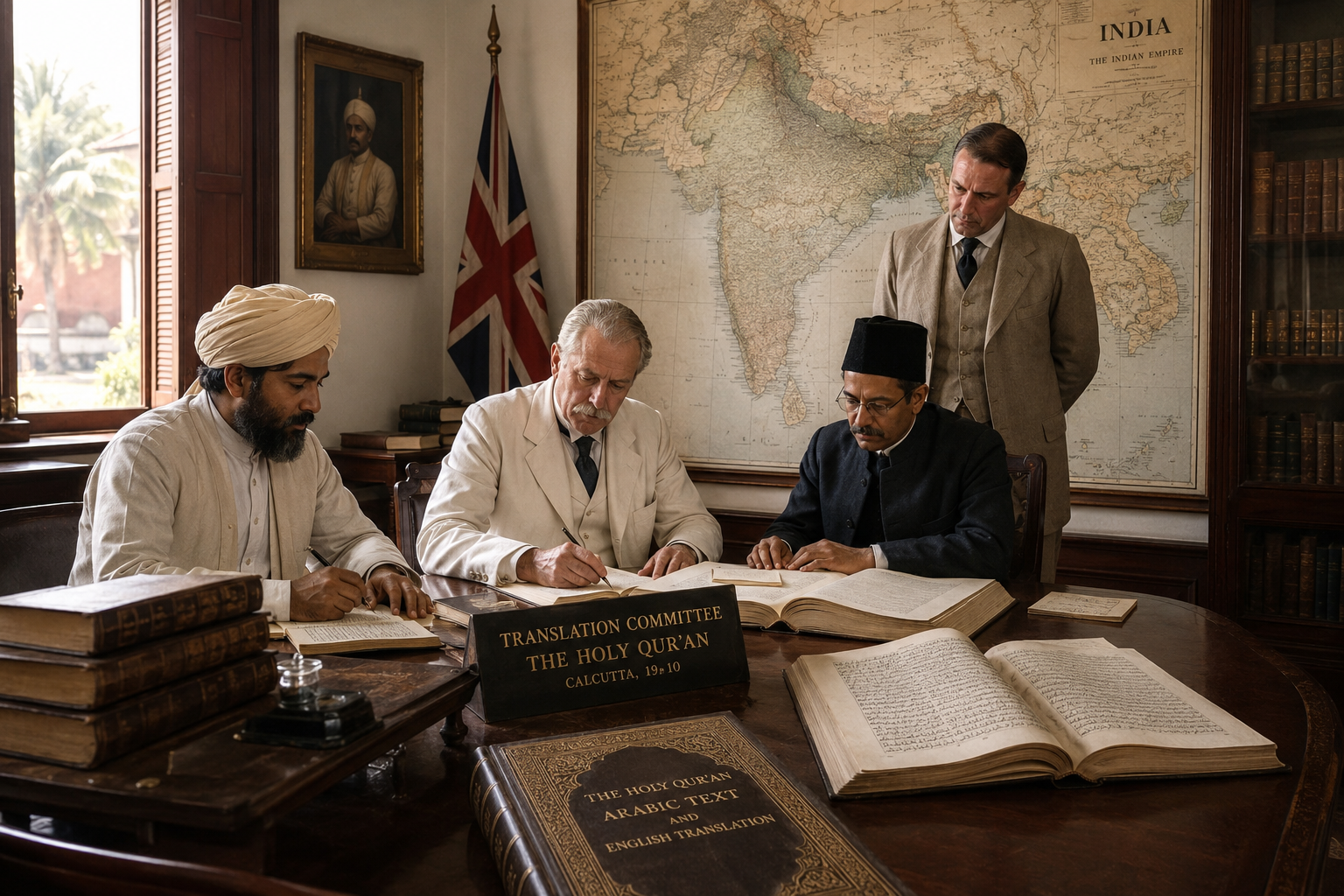
The version of Muslimness that most people in the Western world inhabit today is not an organic transmission of the Ishmaelite covenantal legacy as most like to believe. It is, in very substantial part, a colonial product, a kind of Frankenstein assembled from the dismembered parts of an ancient covenantal tradition and both reshaped and reanimated according to the needs of an empire. When the British arrived in the Indian subcontinent, they encountered something they struggled to process through their existing categories: a living covenantal code, the legacy of the Ishmaelite stewards expressed through Mughal imperial culture. Rather than engage it on its own terms, they reclassified it entirely. Schooled in Enlightenment rationalism and trained in the bureaucratic management of subject peoples, the colonisers severed existential understanding from the real world and called it "religion", removed law from the ethical ordering of society, and created identity from theology. The result was that the Ishmaelite legacy, which had always understood itself as the restoration of the Abrahamic covenant and the continuation of its long moral arc, was pancaked into a sociological category. "Musalman" became, in the colonial imagination, something directly comparable to "Hindu": an ethnic-communal label for a body of customs and a class of people rather than designating a living covenantal obligation between human beings and the Lord of history.
The British then codified this horrid reduction into Anglo-Muhammadan Law, with the surgical precision of administrators who understood exactly what they were doing, extracting the covenantal reasoning of the Proclamation that had given jurisprudence its moral spine and replacing it with something governable and inert. Then in what was perhaps their most strategic move, the text of the Proclamation itself was sullied. The translations produced under the Raj: Sale, Rodwell, and most consequentially Yusuf Ali whose influential rendering was backed by colonial institutions, mediated God's message through the familiar frameworks of Christian theology and secular rationalism. "Islam" became "Mohammedanism," a naming that performed its own type of violence, repositioning the final custodian of the Abrahamic covenant as the founder of a religion rather than the concluding and sealing figure in the oldest restorationist tradition known to humanity. The ancient, living dīn qayyim was thus successfully recast as an ethnic culture, and what was meant to be a universal covenant with God was reclassified as an ethnic community's attachment to its customs.
When South Asian migrants arrived in Britain and North America from the 1940s onward, they carried this recast identity with them, and one can hardly blame them as it was the only frame available to them in the English language and within the English-speaking world. The same transfiguration had already occurred across West Africa, where the Musalman identity had been similarly extended, similarly flattened and similarly named! The Middle East bore its own distinctive wounds with colonial thinking of the British and French variety intersecting with the rise of communist-inflected Pan-Arab nationalism to produce a region alienated from its own Semitic covenantal inheritance by two competing foreign ideologies at once. Arab migrants arriving later in the West and negotiating the same English-language intellectual infrastructure simply adopted what was already there. Today, the Friday pulpit, the translated hadith collections, the popular books and the broader public discourse, all of it operates within the paradigm the European colonisers carefully constructed. Nearly nothing in the English language is immune. Even those of us who speak Arabic import the Arabic we hear into the colonial framework that has shaped our cerebral processing. The Ishmaelite covenant was successfully reframed as a sociological identity, and successive generations have received this colonial construct as though it were the original inheritance, as though the frame and the thing it replaced were one and the same.
It's an inheritance, and like all inheritances, it demands scrutiny rather than simple assumption.
"It is God who brought you out of your mothers' wombs knowing nothing, and gave you hearing and sight and minds, expecting you to be thankful." (16:78)
We arrive empty and are shaped entirely by what surrounds us in those formative years when we have no tools to resist what is poured into us. The question that God places before each successive generation is therefore whether those faculties will be turned on what we have been given, examined with rigour and honesty, or whether we will simply absorb our inheritance uncritically and then mistake passivity for "gratitude", inertia for "piety".
The test of the Exodus Israelites is the test of every generation that inherits a distorted or imbalanced world. These were a people who had been liberated from servitude, and who discovered, to their own discomfort, that freedom was more unsettling than bondage had ever been. Even when it crushes a people, the known carries the seductive comfort of familiarity. Even when it leads toward dignity and covenant fulfilment, the unknown demands a kind of courage one can't always feel in the moment of choosing. And so the Israelites looked back longingly to the cucumbers and lentils of Egypt, drawing from Moses the rebukes: "You want to trade what is better for what is worse?!" The sting in that question lies in what it reveals: it was a question about the capacity to want something proportionate to the subjects God had made them to be, about whether the imagination of a liberated people could reach beyond the menu of their captivity.
There will always be those who push back against the very change that would liberate them, who will interpret their resistance as "discernment" and their fear as "fidelity". They will dress their discomfort in religious language and their attachment to the familiar in appeals to precedent and the authority of those who came before. They are not the custodians of the Abrahamic restoration, instead they are its effective jailers, and their sincerity where it exists, doesn't exactly alter the function they serve. But the Prophet made a promise that ensures they'll never have the final word:
"In every generation, those of upright character among them will bear this knowledge of the code, repelling the distortions of those who overstep, the fabrications of those who corrupt, and the misreadings of the ignorant." (Ahmad, al-Baihaqī)
Three threats are named: The over-steppers distort, the corrupters insert, the ignorant misread. All three are operative today as they have been in every age, taking only the particular forms that each era makes available to them. Those who overstep have turned the covenantal code into a theatre of identity conflict and ritualism. The corrupt have perpetuated the colonial framing with such consistency and institutional confidence that it now passes for religious leadership and genuine scholarship. The ignorant, many of them perhaps sincere and well-meaning, simply transmit what they have received without the tools or the willingness to interrogate it. Be wary: transmission without examination is sleepwalking in devotion's clothing.
The second chapter of the Proclamation, verses 75-78, is instructive here in ways that cut uncomfortably. The Israelite scribal class had heard the word of God and then, having reasoned it through and understood it clearly, chose to misrepresent it deliberately - theirs was a choice rather than a mistake. Meanwhile the common people, uninformed and entirely dependent on what they had been misfed, were left with nothing more than vague hopes and inherited assumptions about who they were what God might want of them. Satan afflicted them with self-delusions that left them to believe, quite baselessly, that they were special for simply being Israelites (ethno-supremacy). The lesson that soberingly emerges from this point is that there was little realistic hope for transformation from a populace shaped by those twin dynamics, and God points out that the Ishmaelites were naive in expecting such a people to ever give them honest credence. So what does this say of modern identities that very palpably traverse the same path?
Nearly a century has now elapsed since the concentrated machinery of the colonial empire reached its historical apex but its categories remain firmly installed as though the dissolution of the formal empire was just administrative rather than conceptual. Its architecture persists in organisations, translations, theological assumptions, and in the very language with which people understand themselves. The empire contracted and eventually withdrew in formal terms but the paradigm it installed didn't follow it home. That gap, between the formal end of colonial power and the uninterrupted persistence of colonial thinking is the space that our generations occupy and must reckon with honestly. The tradition itself has always known this was coming:
"God sends this community, at the head of every century, those who renew the code for it." (Abū Dāwūd)
Renewal is not novelty, nor is it rebellion for its own sake. It is a covenant obligation woven into the very logic by which this ancient tradition has always sustained and reconstituted itself across the turbulence of history. The question before us is not whether renewal will come but whether we will number among those who carry it forward, or be counted instead among those who placed themselves in its way.
We did not choose the world we were born into, nor the Frankenstein of a tradition that was handed to us in place of the original. But we aren't passive recipients either, and the very act of treating ourselves as such is itself a choice made daily, and with consequence. We have hearing, sight, and mind, and these are not decorative. They are instruments of moral agency, and God holds us accountable for what we do with them. The world is the way it is not because it couldn't have been otherwise, but because of choices made by people who came before us - and it will be what it will be in a hundred years because of choices being made now, among them ours as individuals.